Skip to content
AdFreebyBigT

Games

Nonogram by Big T

Classic picross logic puzzles.

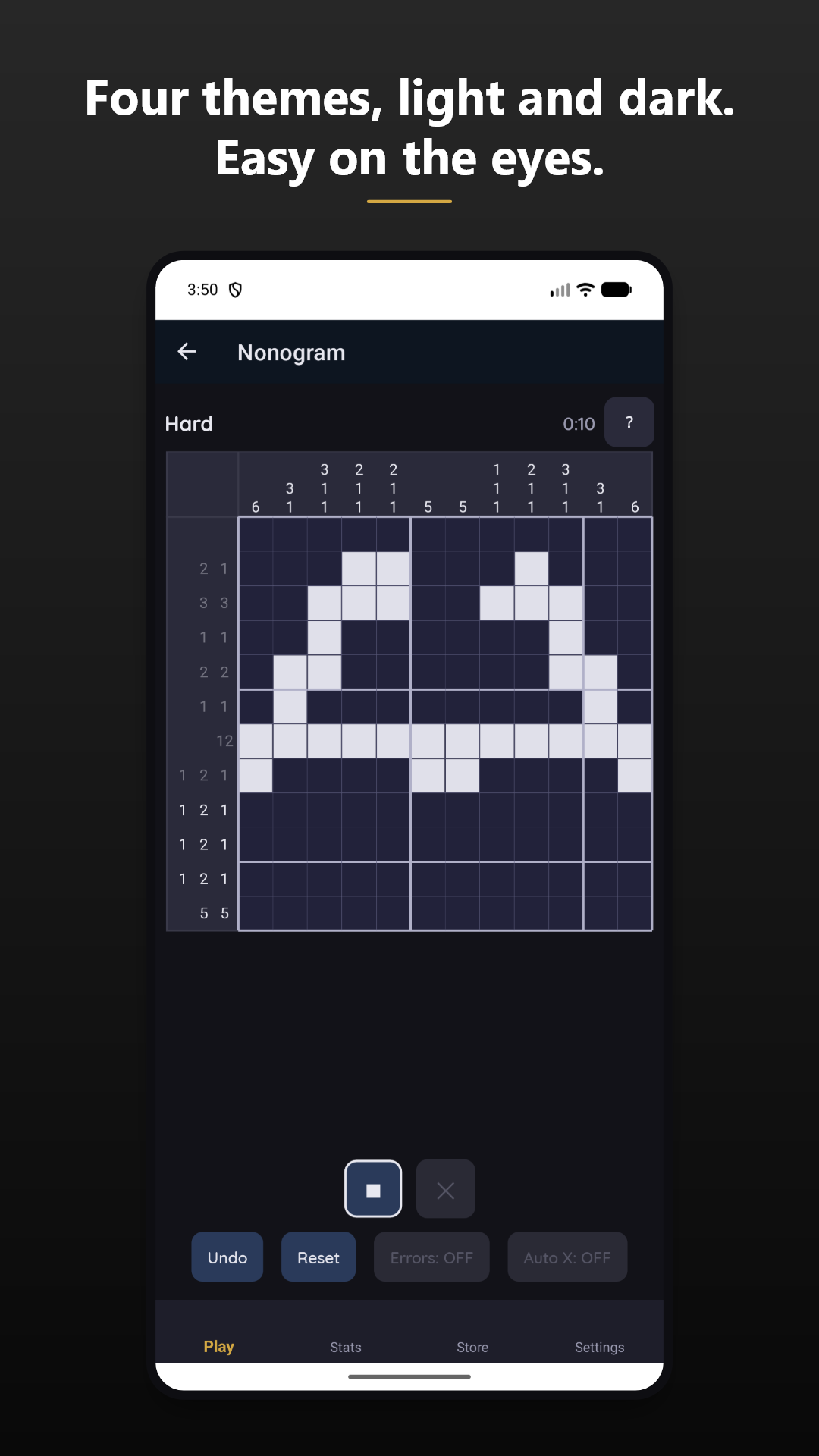
Numbers around the edge tell you the runs of filled squares in each line. Work out which is which and a picture emerges from the grid. Pure deduction — there is nothing to guess, and nothing you need to know in advance.

Nonogram by Big T screenshot 1Nonogram by Big T screenshot 2Nonogram by Big T screenshot 3Nonogram by Big T screenshot 4Nonogram by Big T screenshot 5

What the game is

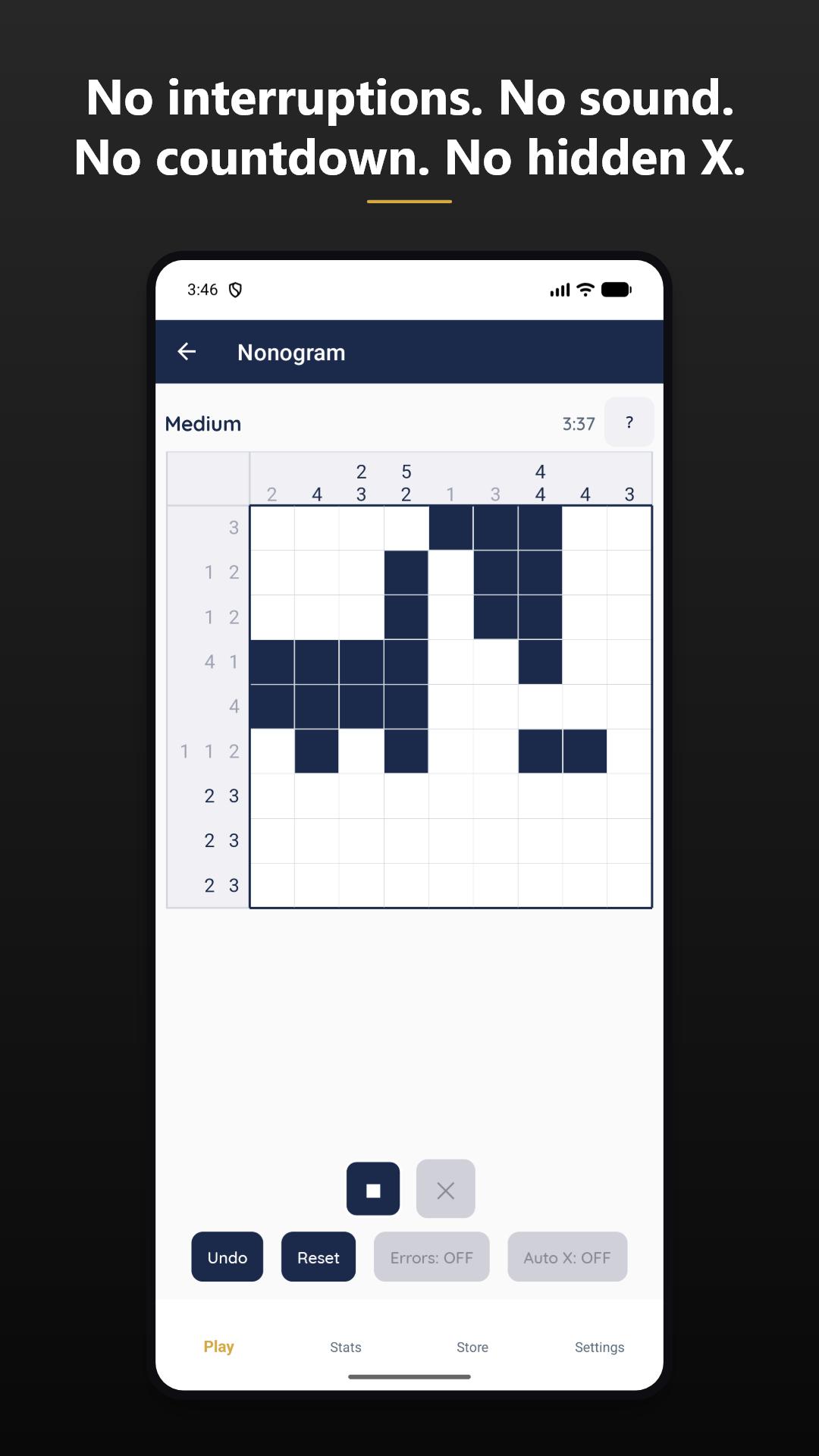
The numbers beside each row and column are the runs of filled squares in that line, in order. A row marked "4 2" has a run of four filled squares, then at least one gap, then a run of two. Where those runs sit is what you work out.

You mark the squares you know are filled and cross out the ones you know are empty. Crossing out is not optional bookkeeping — on the larger grids it is where most of the progress comes from, because an eliminated square constrains every run that could have covered it.

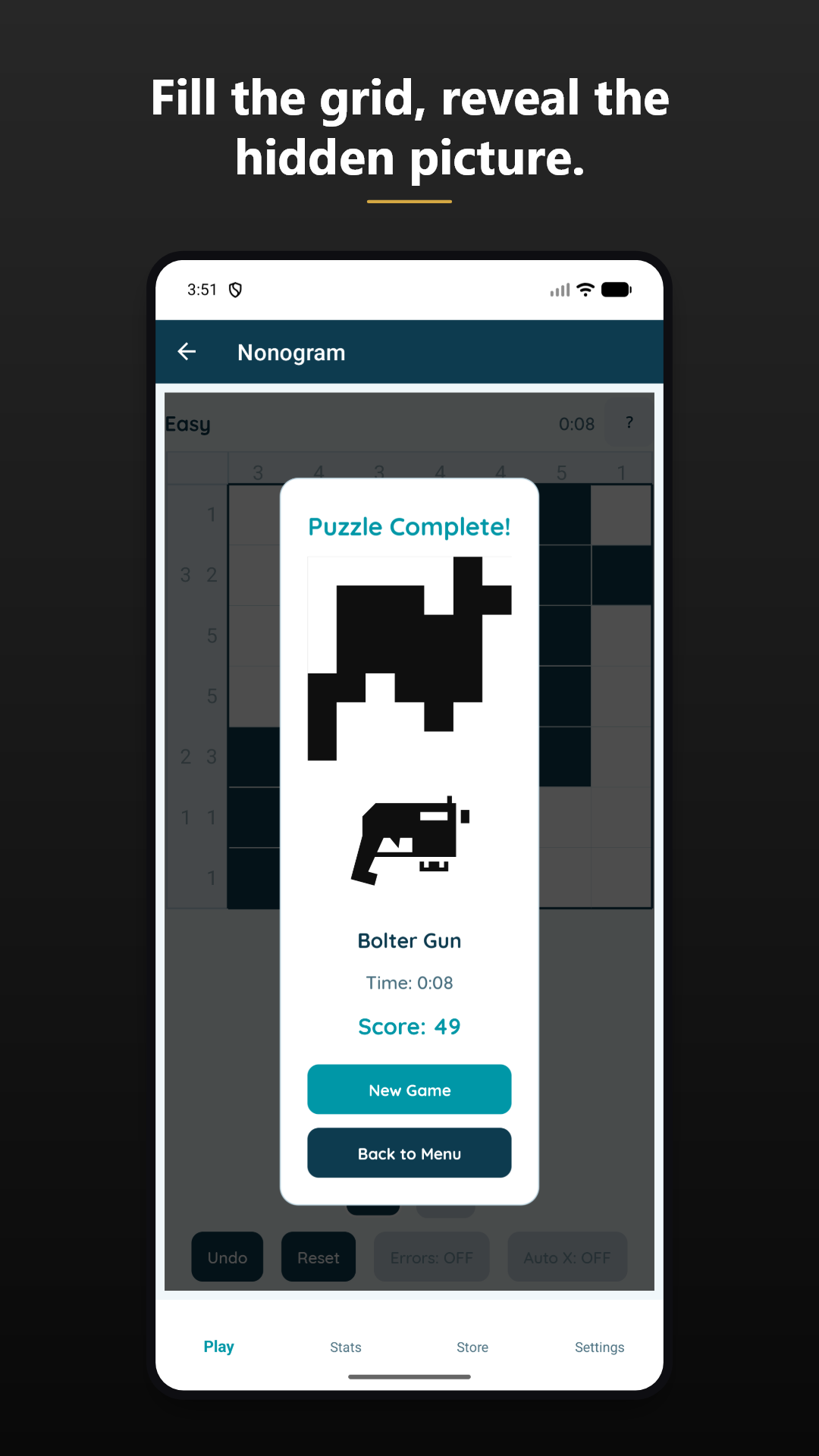
The puzzle is done when every filled square matches its row and column clues. What is left is a picture.

How you play it

Fill and X modes
Two buttons above the board decide what a tap does — fill a square, or cross it out.
Auto X
Crosses out the leftovers in a row or column as soon as its clues are satisfied, so you are not doing bookkeeping by hand.
Overlap
On a short line, a large clue must overlap itself whichever way it slides — those squares can be filled before you know anything else.
Alternate rows and columns
A deduction in a row changes what is possible in every column it crosses. Switching axes is usually faster than staring.

What the four difficulties actually mean

Difficulty is grid size — and which techniques that size demands.

A bigger grid is harder for two compounding reasons: there are more lines to track, and each line is longer, which means the clues constrain a smaller share of it. Overlap does less work on a 15-cell line than on a 7-cell one.

TierWhat it isWhat that changes
Easy 7×7 Clues are large relative to the line, and much of the grid falls straight out of overlap.
Medium 9×9 Overlap still opens the grid, but edges and crossing lines start mattering.
Hard 12×12 The early grid is sparse. Progress comes from crossing out and splitting lines into segments.
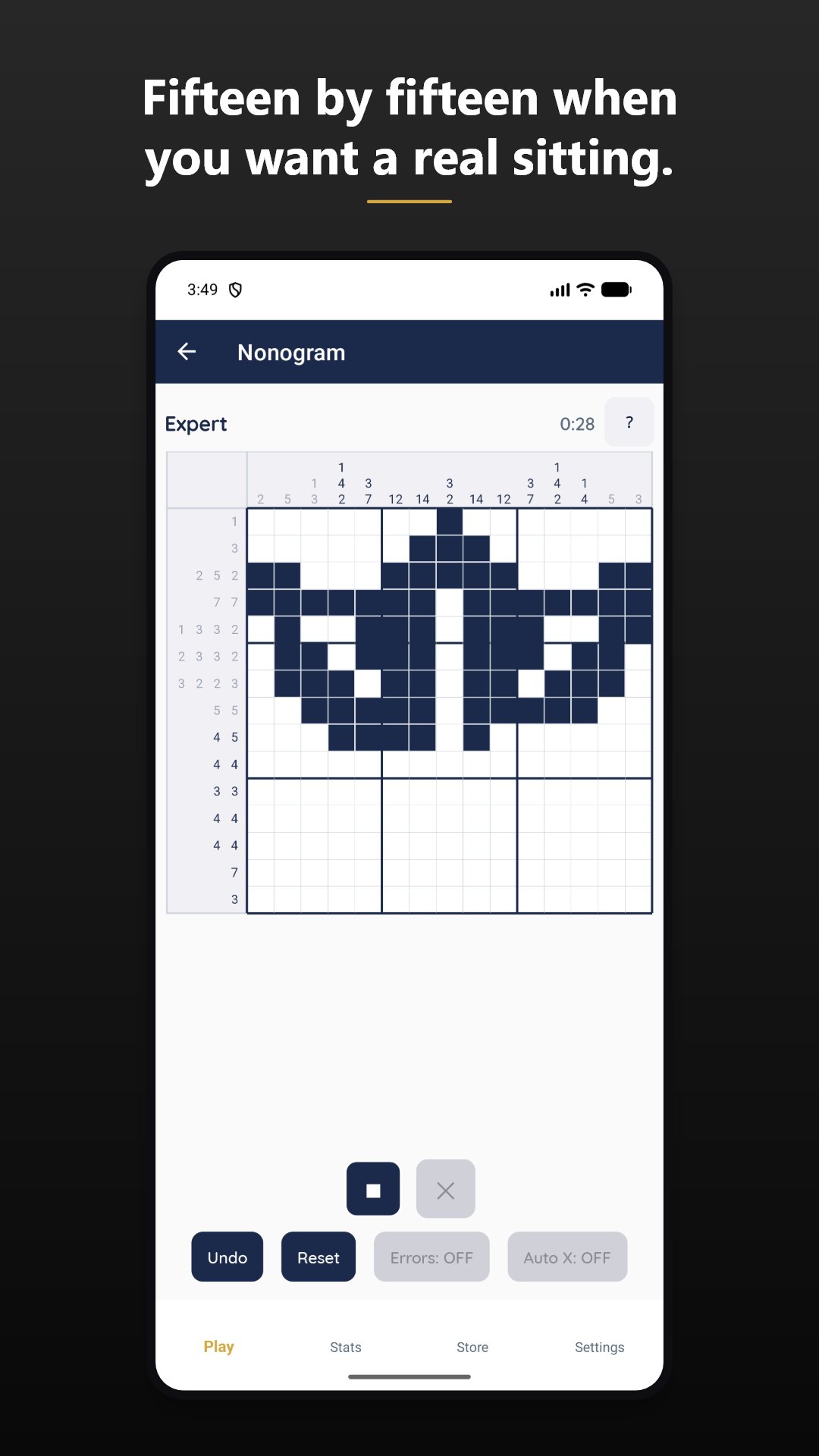
Expert 15×15 Segment reasoning throughout, alternating rows and columns to make headway.

What is free, and what is not

Two hundred puzzles to start — fifty in each of the four difficulties.

Extra puzzles come as packs, sold one at a time. There is no bundle you have to buy to get a fair deal, no "unlock everything" upsell, and no subscription — you buy the pack you want and nothing else.

Easy pack 50 puzzles $1.99
Medium pack 50 puzzles $1.99
Hard pack 50 puzzles $2.49
Expert pack 50 puzzles $2.99

Purchases are tied to the account you sign in with, so they survive a reinstall or a new device. Prices are US dollars; your local store will show its own.
Why these are different

No ads. None.

Not fewer ads, not optional ads, not a "rewarded" video in exchange for a hint. There is no advertising code in the app at all, so there is nothing to interrupt you, nothing to accidentally tap, and nothing that starts appearing later once you are invested.

No advertising ID

The Android advertising ID is absent from every one of our binaries, and none of them asks permission to read it. That is checked automatically on every release build before it ships — it is a property of the artifact, not a promise in a policy.

We do not know who you are

No name, no email address, no phone number, no contacts, no location. When you sign in, the platform offers the app your display name and avatar; the app never reads them.

Your games are not linked to each other

Your identity with us is a one-way salted hash, computed separately for every game. The same person playing two of our games is two unrelated IDs, and we could not connect them if we wanted to — we removed the ability rather than promising not to use it.

Pay once, own it

No subscriptions. No expiring content. No energy timer, no "come back tomorrow", no currency to top up. You buy a puzzle pack and it is yours, on every device you sign in from.

What we do measure

Anonymous gameplay measurements: how long a puzzle took, whether it was finished, how many hints it needed. We use them to check that a puzzle labelled Hard is actually hard. Saying that plainly is stronger than implying nothing is measured — the privacy policy spells out every field.

You should not have to take our word for any of it. See the receipts

Comfort and accessibility

  • Themes — light and dark, plus a choice of colour themes.
  • The timer can be hidden. If a clock on screen changes how a puzzle feels, turn it off.
  • Portrait and landscape, with layout toggles for each: put the controls under your dominant hand on a wide screen, or move them above the board in portrait for easier thumb reach.
  • Tablets and foldables get their own layouts rather than a stretched phone one.
  • Nothing is on a clock. No energy meter, no countdown, no push notification asking you to come back. Your stats keep a day streak if you like watching it climb, but nothing is locked behind it: skip a week and you lose a number, not progress.

Read more

Finished and in final testing. Coming to Google Play soon.